
Meet The Sea Nomads That Can Hold Their Breath For Up To 13 Minutes Under Water

For most of human history, people have lived on land. We build houses, grow food, and travel across solid ground. But for one group of people in Southeast Asia, the ocean has always been home.
They are known as the Bajau, often called the Sea Nomads.
Living Where Land Meets Water

The Bajau traditionally live in coastal and island regions of Southeast Asia, including parts of what is now Indonesia and shouthern Philippines. For generations, many Bajau families have depended on the sea for nearly everything they need.
Their daily lives have long been centered around fishing and gathering food from the ocean. Instead of relying only on boats and nets, Bajau divers often swim down themselves to collect fish, shellfish, and other sea life.
The ocean is central to how they live.
A Life of Diving
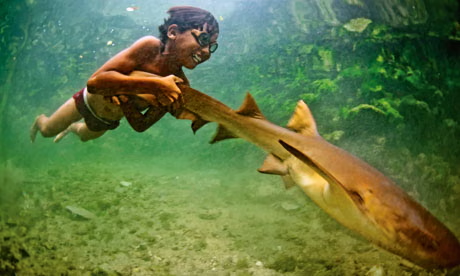
What makes the Bajau Sea Nomads truly extraordinary is their ability to dive deep underwater on a single breath. Many Bajau divers spend up to 60% of their workday in the water, plunging down to spear fish, gather octopus, or collect shellfish. They rise and descend again and again, often for hours at a time, without scuba tanks, fins, or any modern breathing equipment.
Some Bajau can hold their breath for 5, 7, or even 10 minutes, and there are incredible reports of divers staying underwater for up to 13 minutes! That’s far beyond what most humans could manage, even with training or special gear.
For scientists, this ability raised a question: How can the human body possibly survive, and even thrive, underwater for such long periods?
The answer has surprised the world.
A Question Scientists Couldn’t Ignore
At first, researchers thought the answer might simply be practice. After all, the Bajau grow up around the water and learn to dive from a young age.
But training alone did not explain everything.
Even Bajau individuals who did not dive regularly showed physical differences compared to neighboring populations. That suggested the answer might be found inside the body itself.
An Overlooked Organ With an Important Job
One key discovery involved an organ most people rarely think about: the spleen.
The spleen is located under the left side of the ribcage. One of its jobs is to store red blood cells, which carry oxygen through the body.
When a person holds their breath, the spleen can contract and release some of these stored red blood cells into the bloodstream. This temporarily increases the amount of oxygen available to the body.
This response is known to occur in diving mammals and it turns out it happens in humans too.
What Makes the Bajau Unique
When scientists compared the Bajau with nearby non-diving populations, they found that Bajau people tend to have significantly larger spleens on average.
This difference remained even after accounting for factors like age, sex, and body size. Importantly, Bajau individuals who were not active divers also had larger spleens, suggesting the trait is inherited rather than learned.
This finding provided strong evidence that the Bajau’s diving lifestyle is linked to genetic adaptation.
How Genetics Play a Role
Genes are the body’s instructions for how to grow and function. When researchers examined the Bajau genome, they identified genetic regions showing signs of natural selection.
Some of these genes are connected to:
Hormone regulation
Oxygen use in the body
Spleen size
Further studies supported the idea that these genetic changes influence how the spleen develops and how oxygen is managed during breath-holding.
Together, this research shows that the Bajau are an example of recent human evolution changes that occurred over many generations in response to a specific way of life.
Evolution Is Not Just Ancient History

Evolution is often taught as something that happened long ago. But the Bajau remind us that evolution can happen wherever:
A trait helps people survive
That trait is passed down
The environment stays the same over many generations
For centuries, successful diving meant better access to food and resources. Over time, physical traits that supported breath-hold diving became more common within the Bajau population.
This makes the Bajau one of the clearest known examples of how culture, environment, and biology can shape the human body together.
What Scientists Are Still Exploring
Scientists continue to study how much of the Bajau’s diving ability comes from genetics and how much comes from training and environment.
They also study how oxygen use, heart rate, and blood circulation work together during breath-hold diving. While researchers avoid making exact measurements of oxygen advantage, they agree that the Bajau’s physical traits provide a real and meaningful benefit.
Why the Sea Nomads Matter
The story of the Bajau is not just about diving. It helps scientists understand:
How flexible the human body can be
How humans adapt to extreme environments
How evolution continues to shape us today
A Question to Think About
If living by the sea helped shape the Bajau people over generations,how might different environments shape humans in the future?


Comments